An intermittent bonded ribbon production line is designed to produce flexible fiber groups for contemporary, high-count cable architectures. It keeps fibers properly aligned for expedited mass fusion splicing, yet retains flexibility within the fiber group within a compact cable core.
In contrast with fully bonded ribbons, intermittent bonded ribbons feature discrete bonding points at predetermined intervals. This strategic placement keeps the fibers in an organized sequence while the ribbon can flexibly roll into circular loose tubes and other confined spaces.
Fiber network engineers apply this technique when faced with constraints in duct space, splice closures, and equipment racks. A carefully manufactured ribbon cable facilitates dense network deployments in data centers, telecom backbones, metro networks, FTTx feeder systems, and 5G transport networks.
SZ Stranding Line
Fiber Coloring Machine
Fiber Coloring Machine
Main Takeaways
- An intermittently bonded ribbon line enables flexible, high-density fiber arrangements.
- Localized bonds keep optical fibers aligned while preserving ribbon flexibility.
- Flexible ribbons help cable makers fit more fibers into compact circular cable designs.
- Stable fiber order helps accelerate mass fusion splicing.
- Ribbon cable systems support data centers, telecom backbones, and fiber access networks.
Overview Of An Intermittent Bonded Ribbon Production Line
Intermittent bonded ribbon production enables the creation of fiber designs that combine high density with practical handling. This method involves forming bonds at planned positions, allowing for the movement of fiber subunits between these points.
This production approach supports the incorporation of a higher number of fibers within constrained duct spaces. It also preserves the organized ribbon structure, essential for efficient splicing and cable assembly processes.
How Does An Intermittently Bonded Optical Fiber Ribbon Work?
An intermittently bonded optical fiber ribbon connects adjacent fibers at specific intervals along its length. The segments between these bonds remain unencumbered, enabling the ribbon to adopt various configurations without rigidification.
This configuration is often referred to as a rollable, flexible, or spider web ribbon. It diverges from the conventional flat ribbon cable, which maintains a fixed profile along its entire length.
During splicing, the fibers can be arranged into a flat ribbon for mass fusion operations. In cable production, the same fibers create space-efficient bundles, optimizing space utilization within the cable.
Why Flexible Ribbon Technology Matters For High-Density Fiber Networks
Fiber network planners must address the challenge of increasing capacity within densely populated conduits, data centers, and access routes. The flexible nature of a flat cable structure allows ribbon groups to fit into smaller cable cores, preserving fiber order.
Fiber density ratio represents a critical metric for network builders, comparing the space occupied by fibers to the total cable area. Intermittent bonding can improve this ratio, allowing ribbon groups to occupy available spaces within the cable.
For network installers, high-density fiber cables reduce the number of cables required for a given route. This design also supports high fiber counts without necessitating a rigid ribbon stack.
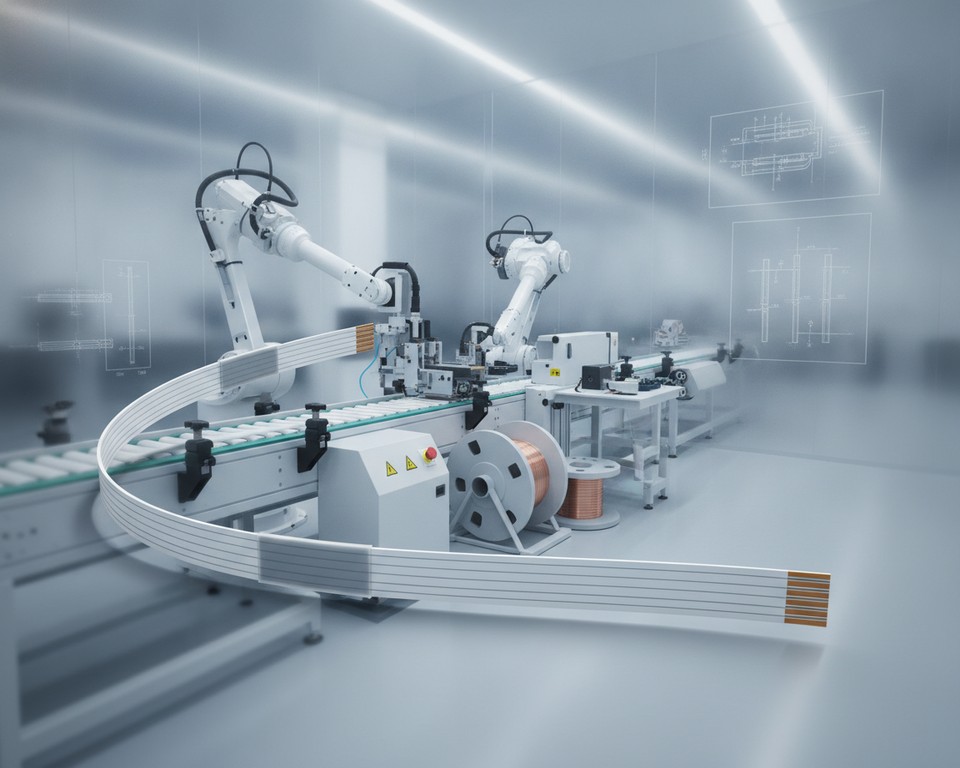 Intermittent Bonded Ribbon Production Line
| Ribbon Characteristic | Flexible Bonded Design | Traditional Continuous Ribbon |
|---|---|---|
| Bond arrangement | Separated bonds at controlled intervals | Bonding maintained continuously along the ribbon |
| Fiber shape between bonds | Can bend, roll, or fold for dense packing | Stays mainly flat and planar |
| Splicing configuration | Can return to a flat format for mass fusion splicing | Remains permanently in a flat ribbon configuration |
| Cable packing role | Supports dense, flexible subunit placement | Uses a more rigid ribbon stack arrangement |
| Common cable use | Flexible flat cable and high-density fiber cable designs | Standard flat ribbon cable designs |
Construction And Material Requirements For Intermittent Bonded Ribbon
A flexible bonded ribbon integrates precise fiber placement with adaptable bonding points. Its architecture facilitates dense cable configurations while allowing effortless separation during handling, routing, and splicing.
Material selection significantly influences ribbon width, peel characteristics, and durability. Each optical fiber subunit must keep its fibers properly positioned without imparting undue stiffness to the ribbon.
Optical Fiber Counts And Subunit Arrangement
Intermittently bonded ribbons can contain 4, 8, 12, 24, or up to 36 fibers. The choice of fiber count is determined by cable capacity, available duct space, and the requirements of subsequent mass fusion splicing.
A 12-fiber ribbon commonly uses six subunits, with two adjacent fibers in each subunit. The fibers within a subunit may be in contact or separated by no more than one and a half times the fiber diameter.
Small gaps placed between subunits ensures ribbon flexibility. These gaps typically span from 5 to 100 micrometers, while the fibers remain aligned side by side across the ribbon width.
| Ribbon Construction Element | Common Arrangement | Process Purpose |
|---|---|---|
| Number of fibers | 4, 8, 12, 24, or as many as 36 fibers | Aligns fiber count with cable density and splice capacity |
| Fiber subunit layout | Two neighboring fibers in each optical fiber subunit | Maintains predictable separation between subunits |
| Spacing within each subunit | Touching or up to 1.5 fiber diameters | Maintains a compact and stable profile |
| Gap between subunits | A typical range of 5 to 100 micrometers | Supports flexibility around bonded locations |
UV-Curable Resin And Wet-On-Wet Bonding
The coating and bond systems frequently employ UV-curable resin systems. Wet-on-wet bonding involves applying the bond material to the uncured subunit coating, which then cures together under UV energy.
This technique generates a diffusion zone where the materials interact. For intermittent bonded ribbons, this zone can range from 2 to 50 micrometers, with 5 to 15 micrometers being the typical focused process range.
UV-curable resin materials can blend at the interface before curing. This facilitates molecular entanglement between the bond and the optical fiber subunit coating, resulting in bonds that are both secure and flexible.
Essential Equipment In An Intermittent Bonded Ribbon Production Line
A fiber ribbon production line combines advanced motion control with meticulous material handling. Each station ensures fibers remain aligned, clean, and stable from the initial payoff to the final winding.
The line equipment manages adjacent fiber placement, subunit coating, intermittent bonding, UV curing, cooling, inspection, and take-up. This sequential process enables manufacturers to manufacture customized flexible ribbon, preserving the integrity of the fiber order.
Fiber Payoff And Tension Control System
Fiber payoff units supply individual optical fibers at a consistent rate from spools. Guides, rollers, and tension sensors prevent sudden pulls, averting twist, slack, or uneven spacing.
During ribbon production, maintaining balanced fiber paths before alignment is critical. Stable tension is essential for forming flat subunits and ensuring accurate color sequence control.
Discrete Bond Applicator And Coating Die
The coating system applies a UV-curable material around groups of two or more fibers. This material defines subunits while maintaining fibers in a flat, parallel layout.
A bond applicator then applies a second resin between neighboring subunits at planned intervals. This spacing allows the ribbon to flex and separate when needed, a critical aspect of custom ribbon cable design.
| Line Equipment | Core Function | Process Benefit |
|---|---|---|
| Payoff and tension unit | Feeds fibers at controlled tension | Minimizes twisting and uneven fiber loading |
| Fiber coating die | Creates coated optical fiber subunits | Maintains consistent subunit shape and width |
| Discrete bond applicator | Places bonding resin at predetermined locations | Forms flexible connections between neighboring subunits |
| UV cure and take-up system | Handles UV curing, cooling, inspection, and final winding | Maintains bond integrity while preserving fiber sequence |
UV Curing, Cooling, And Ribbon Take-Up Equipment
UV curing lamps harden the subunit coating and intermittent bonds while the resin is wet. This wet-on-wet process forms a cohesive interface between materials, influencing bond strength.
Cooling equipment lowers ribbon temperature before inspection and winding. The fiber ribbon line may also employ vision checks to monitor width, bond position, and surface quality.
The take-up system winds the finished ribbon with low, even tension. Proper winding preserves the finished bonded structure, ensuring the custom ribbon cable is ready for later cabling, splicing, or connector assembly.
Fiber Alignment, Preparation, And Color Sequence Management
The foundation of a stable ribbon cable with fiber preparation. Each strand must enter the assembly clean, centered, and in the correct sequence before the coating and bonding processes commence.
Managing Fiber Identification During Splicing And Maintenance
Consistent fiber color identification is indispensable for splicing, testing, and maintenance operations. The standard 12-fiber sequence, typically consisting of blue, orange, green, brown, slate, white, red, black, yellow, violet, rose, and aqua, facilitates swift identification.
When fiber counts increase, the sequence may be repeated within controlled subunits. This method ensures that each ribbon cable remains organized within splice trays, closures, and cable connector layouts.
| Ribbon Fiber Position | Fiber Identification Color | Process Purpose |
|---|---|---|
| 1 | Blue | Marks the first position in the standard color order |
| 2 | Standard orange | Allows quick identification during handling |
| 03 | Standard green | Maintains the specified planar order |
| 04 | Brown | Supports confirmation of subunit position |
| 05 | Standard slate | Provides distinct mid-sequence marking |
| 6 | White | Supports clear visibility during inspection |
| 7 | Red | Improves traceability in splicing records |
| 8 | Standard black | Supports sequence identification inside splice trays |
| 09 | Standard yellow | Aids field restoration work |
| Position 10 | Standard violet | Separates late-sequence fibers clearly |
| 11 | Standard rose | Supports high-count ribbon identification |
| 12 | Aqua | Finishes the standard 12-fiber color sequence |
Avoiding Fiber Twist And Tension Imbalance
Payoff units and guides are instrumental in maintaining fibers in a flat, side-by-side configuration. This prevents twist, crossing, and gaps that could alter the ribbon’s width or distort the bond pattern.
Production personnel carefully check tension across every path before the fibers reach the coating die. Proper alignment is critical for mass fusion splicing and ensures the finished ribbon cable fits its intended cable connector system.
Intermittent Bond Application With UV Curing
Intermittent bonding integrates fiber subunits without solidifying the ribbon into a rigid form. This method allows dense routing and ensures dependable handling within a flexible flat cable. It also aids in maintaining the planned fiber layout during subsequent cable assembly.
Applying Bonds At Predetermined Intervals
The production equipment applies bonding points at intervals ranging from 10 mm to 1,000 mm. The bond locations may stagger along the ribbon’s length. This arrangement provides support to adjacent subunits while allowing sufficient free length for movement.
A controlled applicator deposits a measured amount of UV-curable resin at each bond point. Bonds often exhibit a diamond-like shape, with wider centers and narrower ends. The tapered ends help minimize localized stress changes when the cable bends or twists.
Building Strong Yet Flexible Bond Interfaces
Wet-on-wet processing requires applying a second material before the first subunit coating cures. The uncured layers can blend before undergoing a shared UV curing step. This approach fosters a gradual interface, unlike a sharp material boundary.
This gradual interface influences various properties, including color, Young’s modulus, and surface friction. Bond ends may feature saddle-like surfaces with both convex and concave curves. These features enhance the cable’s resistance to peeling while facilitating separation when required.
Managing Curing Performance
UV curing systems must deliver consistent energy across the ribbon. Factors such as line speed, lamp output, resin volume, and exposure time impact the bond’s quality. Selecting the right UV-curable resin ensures rapid curing without compromising the fiber coating.
Production operators monitor bond shape, cure level, and ribbon flexibility during production. The cured cable should transition smoothly from a flat plane to various forms without bond damage. Controlled curing ensures consistent handling throughout winding and downstream processing.
Quality Control For Flexible Flat Cable And Fiber Ribbon Output
Verifying every flat ribbon cable is a meticulous process. It involves checking the cable’s flexibility and its readiness for subsequent splicing operations. During production, operators assess the fiber count, color sequence, and precise positioning of each fiber. They also evaluate the cable’s winding condition, ensuring its optimal state for assembly.
Routine inspection is essential in identifying any defects in the coating, uneven tension, or misplaced bonds. These issues, if left unaddressed, could compromise the cable’s performance in subsequent stages of production.
Checking Bond Spacing, Ribbon Width, And Thickness
The distance between bonding points is a critical parameter, requiring adherence to a specific design range. This spacing is essential for the cable’s flexibility, ensuring that the fibers remain aligned within their designated subunits during bending.
Quality checks are performed to confirm that each bond correctly connects adjacent subunits. This attention to detail ensures that the ribbon lays flat, facilitating smooth mass fusion splicing processes.
| Inspection Point | Items Checked | Quality Benefit |
|---|---|---|
| Fiber identification | Fiber number, color order, and placement | Supports reliable splice records and maintenance activities |
| Bonding pattern | Bond placement, separation distance, and subunit joining | Maintains flexibility and fiber organization |
| Ribbon profile | Width, thickness, and flatness | Supports compatibility with handling and splice equipment |
| Ribbon surface condition | UV cure state, coating coverage, and defects | Helps minimize handling damage during winding |
Optical And Mechanical Performance Testing
Mechanical assessments focus on bond separation, cohesive strength, elongation, and handling behavior. These evaluations are essential to confirm that the manufacturing process controls are consistent across similar designs of flat cables.
Optical inspection involves evaluations after bonding and curing. It ensures that the core, cladding, primary coating, secondary coating, and color layer are adequately protected throughout the manufacturing process.
Attenuation checks and splice-related handling tests are integral to routine inspections. The quality of winding is also scrutinized to ensure that the finished flat ribbon cable is in a controlled condition for assembly.
Precision Winding, Automation, And Production Efficiency
The essence of efficient ribbon production on a unified production line. Each stage, from fiber payoff to inspection and take-up, must harmonize seamlessly. This synchronization ensures the preservation of fiber geometry and facilitates consistent output, critical for high-speed data transmission cables.
Process Data Monitoring And Line Synchronization
Control systems integrate payoff speed, fiber tension, resin delivery, bond placement, UV curing, cooling, and take-up. Adjustments are made in real time to maintain ribbon stability when speed variations occur at any station.
Manufacturing data records capture fiber color sequences, bond intervals, cure settings, ribbon dimensions, and winding status. This detailed history allows operators to track the production of each custom ribbon cable.
- Payoff tension prevents fiber stretch and slack.
- Controlled bond timing maintains regular intervals between bond points.
- Dimension monitoring identifies width and thickness variations quickly.
- Take-up data helps with production lot tracking and later processing.
Winding Ribbon For Downstream Cable Production
A precision cable winder helps ensure the ribbon is wound onto a spool with uniform tension and controlled movement. This method prevents edge crushing, layer crossing, and sudden pulls during subsequent cable processing.
Finished ribbon structures may be stacked, rolled, or loaded into central tube and loose tube designs. These configurations enable the creation of high-speed data transmission cables, even in areas where duct additions are impractical.
For custom ribbon cables, the winding pattern must align with subsequent processes. Proper spool buildup is essential for smooth payout during stranding, tube loading, and cable assembly.
| Process Area | Control Focus | Downstream Benefit |
|---|---|---|
| Fiber payoff | Consistent tension with correct fiber color order | Consistent ribbon organization during cable assembly |
| Intermittent bond application | Controlled bond intervals and resin quantity | Flexible ribbon behavior during handling |
| UV cure stage | Stable UV lamp output and cure exposure | Properly cured bonds before ribbon winding |
| Cable winding system | Uniform traverse with controlled spool tension and layering | Controlled ribbon feed into loose tube or central tube production |
Ribbon Cable Applications, Fusion Splicing, And Connector Planning
Ribbon fiber is instrumental in dense links within data centers, telecom backbones, metro rings, and FTTx feeder routes. It also excels in indoor FTTH runs, 5G fronthaul, and outdoor point-to-point networks where space is at a premium.
A meticulously planned ribbon cable assembly enables crews to manage high fiber counts efficiently, without increasing bulk. Each high-speed data transmission cable must align with the site’s route, enclosure space, and future expansion plans.
Mass Fusion Splicing Advantages
A ribbon fusion splicer facilitates the joining of an entire ribbon in a single operation. For a 12-fiber ribbon, a matching cleaver can prepare all 12 fibers simultaneously before the automated fusion process commences.
This method reduces handling time and ensures consistent fiber alignment. Splice loss is reported to remain below 0.05 to 0.10 dB per fiber, contingent upon controlled preparation, cleaning, and machine settings.
Loose tube cable, by comparison necessitates a different strategy at the splice cassette. Technicians must separate the fibers, then splice them individually, which prolongs the ribbon cable assembly process.
Planning Connections For Dense Fiber Links
Multi-fiber connections commonly use MPO or MTP trunks, harnesses, fanout cables, and cassette modules. The chosen cable connector must align with the fiber count, polarity method, connector gender, and fiber type.
Planning also considers transceiver requirements and the full link loss budget. A high-speed data transmission cable, when used with parallel optics, demands a clear polarity path from equipment port to patch panel.
| Connection Planning Item | What It Controls | Common Network Use |
|---|---|---|
| Fiber ribbon count | Fusion splice capacity and cassette choice | Backbone links using 12-fiber or 24-fiber ribbons |
| MPO or MTP multi-fiber connector | Polarity management and equipment port compatibility | High-density data center and 5G equipment-room connections |
| Multi-fiber harness or fanout assembly | Transition from multi-fiber connections to single-fiber ports | Switch connections and patching fields |
| Network loss budget | Permitted optical loss across splices, connectors, and fiber | High-speed fiber cable network paths |
Shanghai Weiye OFC Equipment For Ribbon Line Projects
Shanghai Weiye OFC Equipment, also known as SHWY, specializes in machinery for the production of optical fibers and cables, serving markets in the United States and globally. Its offerings are designed to maintain stable production, facilitate clear operator control, and enable seamless integration into production lines.
For initiatives requiring an intermittent bonded ribbon production line, SHWY equips each phase of ribbon handling, curing, and winding with suitable machinery.
SHWY Experience With Optical Fiber And Cable Machinery
Established in 1998, SHWY’s journey in the industry has been marked by significant milestones. By 2012, its annual turnover surpassed 200 million CNY, strengthening its position within a prominent Chinese fiber and cable conglomerate as a joint venture.
During 2020, SHWY moved to independent operation, relocating to a state-of-the-art facility in central Shanghai. This move underscored its commitment to advancing equipment research, manufacturing, and process application while supporting operational stability.
Relevant Production Equipment From SHWY
SHWY offers a diverse range of equipment, including fiber draw towers, coloring machines, secondary coating lines, SZ stranding equipment, and cable sheathing lines. Notably, it also features a fiber ribbon line tailored for flat, high-count fiber formats.
For ribbon projects, a cable precision winder plays a critical role in maintaining orderly package buildup and controlled tension. This ensures safer transport and more consistent feeding into subsequent cable production stages.
The broader SHWY portfolio also includes FTTH lines, indoor cable equipment, and OPGW fiber-in-stainless-steel-tube systems. These options enable manufacturers to integrate an intermittent bonded ribbon production line with complementary cable processes.
Final Thoughts
An intermittently bonded ribbon production line combines fiber alignment, controlled bonding, UV curing, inspection, and precision winding into a unified process. Each step maintains organized fiber positioning while maintaining the necessary bendability for dense cable designs. This combination is critical for the creation of high-density optical networks.
The resultant ribbon cable supports efficient mass fusion splicing and organized fiber management. It is ideal for applications with high fiber counts, confined ducts, limited tray space, and frequent splice points. This makes it a cornerstone in many high-density ribbon cable routes.
Effective project planning extends beyond the production line. It encompasses the cable structure, closure capacity, fusion tools, test methodologies, labeling, and restoration records. These elements must align with the planned network architecture for seamless integration.
Related: Introduction To Fiber Coloring Machine Technology
Best Best CNC Machine Shop in Houston